Annuity Misconceptions: What You Should Know

When it comes to retirement planning, annuities are one of the most misunderstood financial tools. Misconceptions and outdated beliefs often prevent investors from exploring how annuities can provide guaranteed income, protect assets, and support long-term financial security. By clearing up the most common myths, you can better understand the role annuities may play in your retirement strategy.
Misconception #1: “I won’t run out of money — I don’t want or need guaranteed income.”
According to a 2025 Goldman Sachs report, more then half of working Americans (58%) believe they will outlive their retirement savings—and their concern is understandable.1
Annuities offer an efficient means of generating retirement income. Annuities can quickly outperform fixed income in generating retirement income and provide payouts long after fixed income portfolios would be depleted. Annuities should be considered, especially if you are likely to outlive the average life expectancy.
More than 4 in 5 workers have expressed an interest using their retirement savings to purchase a guaranteed income product that paid on a monthly basis.2
Misconception #2: “I don’t want or need annuities.”
The annuity market is a $4.3 trillion market, with U.S. annuity sales reaching a record $464 billion in 2025 — showing a clear desire for guaranteed income solutions among consumers and retirees.3 It is well documented that annuity owners can experience psychological benefits in knowing that essential expense are covered, which gives them the freedom to spend discretionary savings. Retirement expert Michael Finke found that retirees spend about 80–85% of their guaranteed lifetime income, but only about half of what they could draw from their savings.4
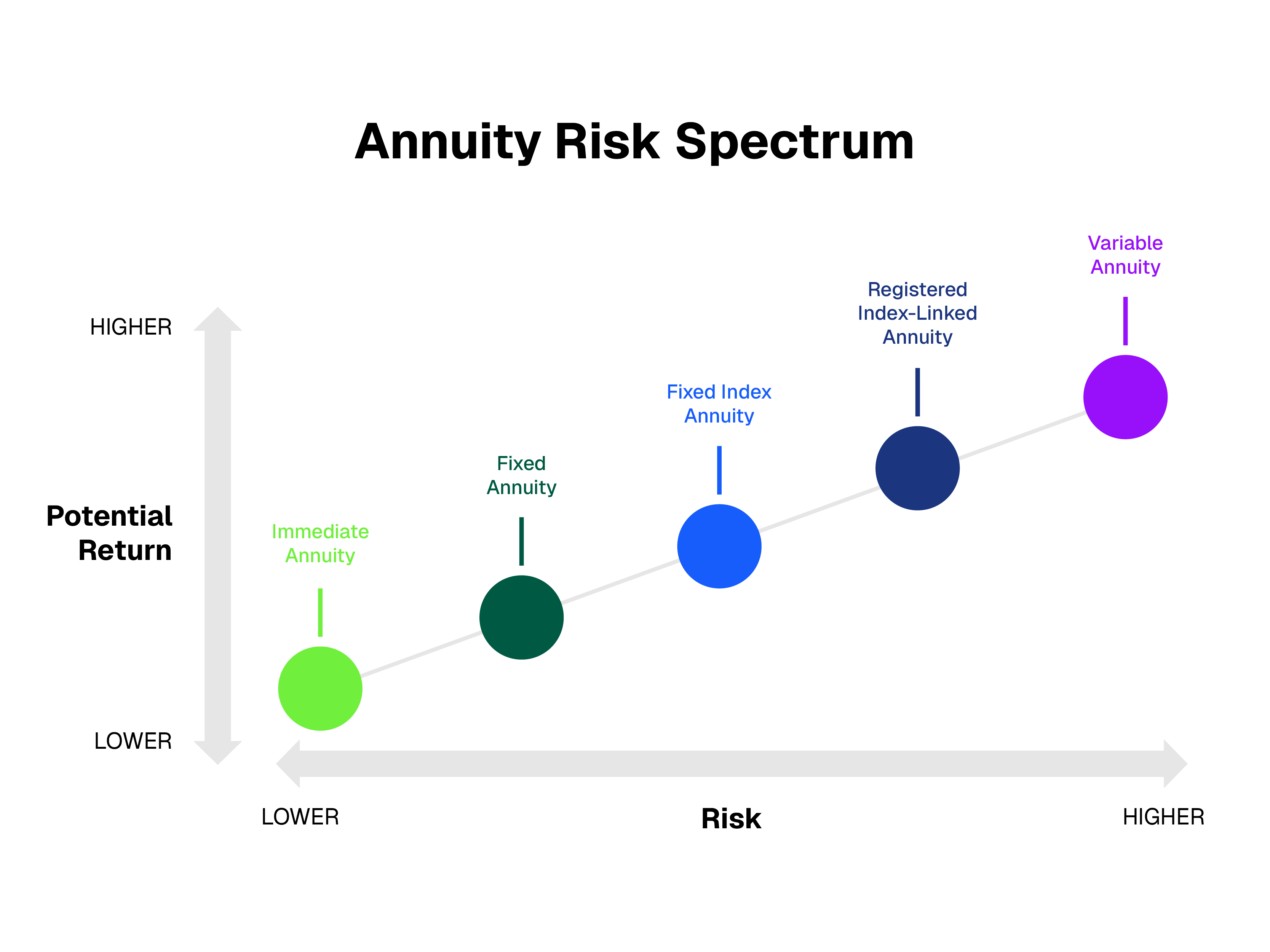
Misconception #3: “My fixed income portfolio can outperform an annuity.”
An annuity is built on the insurance carrier’s balance sheet, which resembles a large, scaled bond ladder. So, insurance products will often perform like fixed income investments, but where they shine relative to traditional fixed income portfolios is in the income they can generate.
We encourage you to run the numbers to see how an annuity is able to provide secure retirement income relative to a fixed income strategy.
Misconception #4: “Income is generated through annuitization.”
Annuitization is the process of converting an annuity investment into a series of periodic income payments. Annuitization is an irreversible allocation of funds — and you may lose cash value and a death benefit when if you annuitize. It is important to note that only a small number of annuities are ever annuitized — industry estimates have long put it below 5% —and immediate income annuities accounted for only about 3% of U.S. annuity sales in 2025.5
Single premium immediate annuities (SPIAs) generate income through annuitization. For every other annuity — while you can annuitize — it is more common for income to be generated through riders. This is important because you are not turning over assets to the insurance company to generate income. When income is generated using a rider, cash value remains available until it is depleted through distributions.
Annuities are a powerful tool to generate income in a retirement plan — income now, income soon, or income later. Without annuitization, annuities can provide reliable income to a retirement portfolio based on your liquidity, flexibility, and payout rate preferences.
Misconception #5: “All annuities have surrender periods.”
More often than not, commission-free annuities do not have a surrender period. If these products do include a surrender charge, it functions more like an early withdrawal penalty than a fee to recoup the expense of the commission. Because these shorter surrender windows help carriers manage duration risk, investors can benefit from higher interest rates and lower overall fees.
Misconception #6: “I'll wait for rates to go higher before I buy an annuity.”
Rising interest rates are good news for both income-focused investors and annuity owners. Insurers invest largely in bonds, so as yields climb, the rates offered on multi-year guaranteed annuities (MYGAs) and the payouts on income annuities generally rise with them. However, since bonds can lose market value when rates go up, a MYGA held to term credits a guaranteed rate that doesn't fluctuate with the bond market.
Waiting for rates to peak is a gamble, since rates can fall as quickly as they rise. Laddering purchases across several MYGA terms lets you lock in today's rates while keeping room to capture higher ones later.
Annuities have evolved, yet many investors still hold onto outdatedbeliefs that prevent them from seeing their value. By separating misconceptionsfrom the truth, it becomes clear that annuities can be a powerful way togenerate reliable income, reduce financial stress, and strengthen retirementstrategies.
Whether you’re seeking income now, soon, or later, understanding the truth about annuities ensures you can make confident, informed decisions about your financial future.
DPL has several tools to help you learn more about commission-free annuities and see how these solutions fit in a retirement portfolio.
Disclosures
1Goldman Sachs Asset Management, 2025 Retirement Survey & Insights Report
2Employee Benefit Research Institute, 2026 Retirement Confidence Survey
3American Council of Life Insurers, 2025 Life Insurers Fact Book; LIMRA, 2025 U.S. Annuity Sales
4Michael Finke, Standard Deviations Podcast; “Putting the ‘IS’ into ERISA,” 2026
5LIMRA, 2025 U.S. Annuity Sales
.avif)