


Two retirees. Same portfolio. Same average return over 20 years. One runs out of money at 78. The other leaves a substantial legacy.
The difference? The order in which those returns arrived.
For advisors managing clients through the retirement transition, sequence of returns risk is one of the most dangerous—and most preventable—threats to long-term portfolio sustainability. Understanding how it works, and how to mitigate it, is essential to delivering on the promise of a secure retirement.
What Is Sequence of Returns Risk?
Sequence of returns risk is the danger that the timing of poor market returns—particularly in the early years of retirement—can permanently diminish a portfolio's longevity, even when long-term average returns remain healthy.
During the accumulation phase, the order of returns is largely irrelevant. A portfolio growing untouched over 30 years will reach the same endpoint whether gains come early or late—the math of compounding is indifferent to sequence. But once a retiree begins taking withdrawals, the equation changes dramatically.
Financial planners often refer to the "fragile decade"—the five years before and five years after retirement. Negative returns during this critical window force retirees to sell assets at depressed values to fund living expenses, locking in losses that the portfolio may never recover from, regardless of subsequent market performance.
Why It Matters More Than Market Risk
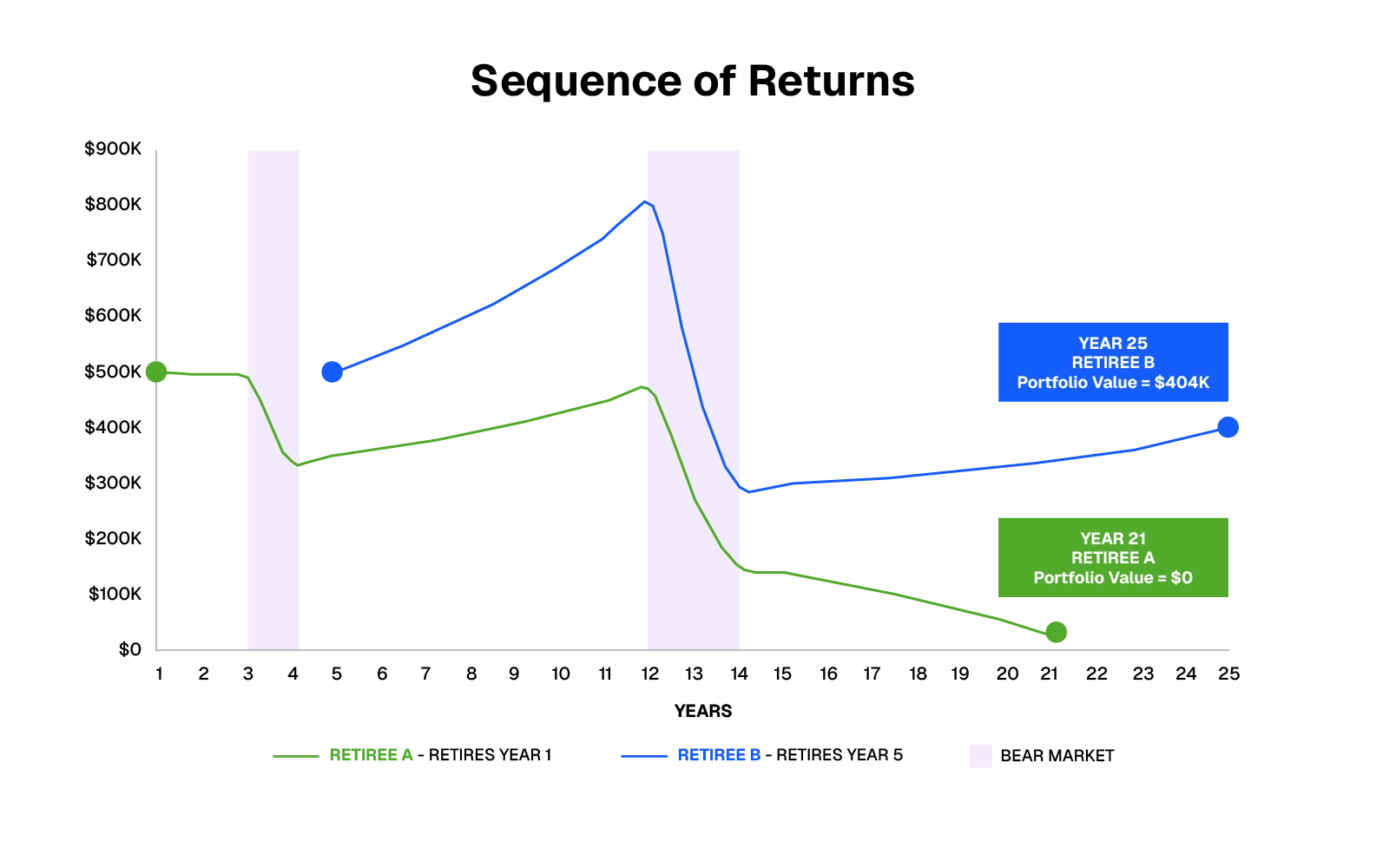
Consider this hypothetical example: Two retirees each begin with a $1 million portfolio and withdraw $50,000 annually, adjusted for inflation. Both experience the exact same set of annual returns over 20 years—but in reverse order.
- Retiree A experiences strong returns in the early years followed by weaker performance later. After 20 years of withdrawals, their portfolio still holds over $800,000.
- Retiree B faces poor returns in years one through five, followed by the same strong returns that Retiree A enjoyed early on. Despite identical average performance, they run out of money before year 18.
Same average return. Opposite outcomes. That is the core math behind sequence risk.
During accumulation, a 20% portfolio loss followed by a 25% gain returns you to roughly breakeven. During decumulation with ongoing withdrawals, that same sequence creates a permanent deficit—because the retiree sold shares at depressed prices, and fewer shares remain to participate in the recovery.
How Advisors Can Mitigate Sequence Risk
The most effective sequence risk mitigation strategies share a common thread: reducing portfolio withdrawal pressure during the vulnerable early years of retirement.
Time-segmented (bucket) strategies allocate near-term income needs—typically the first three to five years—to stable, low-volatility assets such as short-term bonds or cash equivalents. This allows growth-oriented holdings time to recover from potential downturns before they need to be liquidated.
Guaranteed income flooring using Commission-Free SPIAs, DIAs, or FIAs establishes a baseline of contractual income that does not depend on market performance. When essential expenses are covered by guaranteed sources, advisors can significantly reduce—or even eliminate—the need for portfolio withdrawals during down markets. This is arguably the most powerful tool available for neutralizing sequence risk.
Dynamic withdrawal policies that adjust annual spending based on portfolio performance provide an additional layer of protection, though they require greater client flexibility and clear expectations-setting during the planning process.
The most robust approaches combine multiple strategies. A guaranteed income floor paired with a bucket strategy, for example, gives clients both the certainty of contractual income and the growth potential of a diversified portfolio—without requiring them to sell equities during the worst possible moments.
For RIAs evaluating these solutions, Commission-Free annuities remove the conflict-of-interest barrier that has historically kept fee-only advisors from recommending guaranteed income products. DPL's Consultants help advisors identify the right product structures for each client's income timeline—without introducing commission-driven bias into the recommendation.
Protecting Clients Where It Matters Most
Sequence of returns risk is one of the most underappreciated threats in retirement planning—and one of the most addressable. Advisors who proactively build guaranteed income floors and diversify withdrawal sources position their clients to weather early-retirement volatility without suffering permanent portfolio damage.
The math is unforgiving, but the solutions are available. The advisors who help clients navigate this risk effectively are the ones who earn lasting trust and long-term relationships.
This is a hypothetical example for illustrative purposes only and is not representative of the future performance of any product. Past performance is no guarantee of future results.
All guarantees are based on the financial strength and claims-paying ability of the issuing insurance company.
FOR REGISTERED INVESTMENT ADVISOR USE ONLY. NOT TO BE USED FOR CONSUMER SOLICITATION PURPOSES.